|
|
 |

ABOUT THE PLAY AND PLAYWRIGHT
by Jacque Troy
Much of what is fascinating, if not entirety true,
about Carlo Goldoni's life
can be read in Memoirs of Carlo Goldoni: Written by Himself This curious
and passionate account represents the reconstructed memories of a 75-year-old
man; five years from his death and enamored with the life he had so joyously
lived.
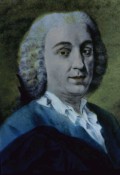
Carlo Goldoni, born in Venice in 1707, was destined for a theatrical career
by virtue of his ancestry. His paternal grandfather loved the performing
arts. Even when there was little money, Goldoni celebrated life by regularly
hosting operas and plays featuring Italy's most gifted actors and musicians.
Carlo's father, Giulio Goldoni, also nurtured his son's love of theater with
a puppet stage.
In fact, not only did Carlo's father arrange the tiny theater's construction,
but he called upon the talents of his friends to write and perform pieces
for his four-year-old son. At this tender age, the young Goldoni was quite
accomplished at reading and writing. In his own memoirs, Goldoni recalls
hours spent in his father's library with his books, "I employed almost all
my leisure moments in reading them. I even copied the passages with which
I was most delighted."
Given his early love of books, perhaps it is not surprising that Goldoni
claims he wrote his first comedy at the age of eight. Though scholars disagree
with his version of the story, it is a charming notion. According to Goldoni,
when his father received this first playwriting sample, he insisted that
his talented son join him in Rome. In 1712, Giulio Goldoni had left his family
behind to study medicine. Reunited with his father, Carlo continued his own
schooling and, during holidays, Giulio made provisions for his son to perform
in amateur productions. During this experience, it became clear that Carlo
Goldoni would never be an actor!
Instead, Carlo's father hoped that he would become a physician like himself
However, young Goldoni was very unhappy with the profession. Seeing this,
Carlo's mother found a way for her son to pursue study in the law through
employment with an attorney in Venice.
At 16, Carlo Goldoni received the opportunity to continue these studies at
the College of Ghislieri, known as the Pope's College. The unusual requirements
for entry were a certificate verifying good moral conduct, a certificate
proving he was unmarried, a baptismal certificate, and, if the church were
to supply funds, Carlo must shave the crown of his head in an appropriate "tonsure." Opting
to keep his hair in exchange for a lot of red tape, Goldoni applied for and
received funding from the senate. Additionally, a fortunate error wit his
birth certificate showed his age to be 18, allowing him to pass the minimum
age requirement.
While on summer holiday, Goldoni engaged in his favourite past time: reading
comic plays. During his first summer at home, he was given a copy of Niccolò Machiavelli's
THE MANDRAKE which would play a huge role in the creation of his later works. "It
was the first comedy of character which had ever fallen into my hands and
I was quite enchanted with it."
 Goldoni's
third year at university would unfortunately be his last. Tricked
by
Goldoni's
third year at university would unfortunately be his last. Tricked
by
jealous classmates, he was placed under house arrest for possession of pistols.
Assured that his pen would prove an even mightier weapon for revenge, Goldoni
was encouraged to write an Atellano. This short, farcical dramatic form originated
with the Romans. Its subject matter most often involved cheating, gluttony,
fighting, and sexual exploits. Goldoni's "characters" would be several
respectable Italian families who immediately demanded his expulsion for the
comic work. Their wish was granted.
This expulsion would send Goldoni back to the study of law in 1727. He would
finally receive his doctorate from the University of Padova in 1731 and be
admitted to the bar a year later. Perhaps guided by his "theatrical" nature,
Goldoni won his first big case in 1733, but fled the city immediately afterward
to escape huge financial pressures and an unwelcome marriage.
Finally, in 1734, Goldoni officially began his career as a playwright by
writing scenarios for commedia troupes in and around Venice. However, from
the beginning, he was unhappy with many of the forms conventions. He began
to encourage reform in 1738 by writing out the principal role in MAN OF THE
WORLD. Five years later, Goldoni would write his first complete comic text
called A LADY OF CHARM, but would not see it performed because of his need
to flee from bad debts once again.
The partnership he began with masterful commedia actor Antonio Sacchi on
MAN OF THE WORLD would provide Goldoni's next major writing job.
In 1744, Sacchi requested a written scenario for SERVANT OF TWO MASTERS which
was based on an older French theme. The play premiered in Milan a year later,
but would not boast a complete text by Goldoni until nine years later. His
many successes following SERVANT OF TWO MASTERS encouraged Goldoni to alter
the traditional character types for later works. A GIRL OF HONOR in 1749
would mark the first time commoners were given equal importance on the stage.
In that same year, THE GENTLEMAN AND THE LADY would be the first Italian
comedy performed without masks. The nobility would continue to be outraged
by this innovation for the next 10 years!
By 1761, when Goldoni left Venice, he had done much to eliminate vulgarity
and unrealistic devices from commedia. Instead, he concentrated on finding
ways to include humor, sentiment, and realism. The stock characters appeared
softer and more human under Goldoni's pen.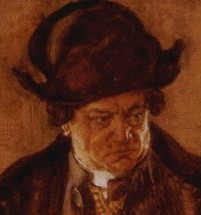 His
later works also revealed his respect for the middle and lower classes and
particularly women. his respect is most clearly illustrated in one of his
most famous works, THE MISTRESS OF THE INN.
His
later works also revealed his respect for the middle and lower classes and
particularly women. his respect is most clearly illustrated in one of his
most famous works, THE MISTRESS OF THE INN.
Late in his life, trouble with his eyes forced Goldoni to discontinue much
of his writing. This, combined with government reform, would plunge Carlo
Goldoni into utter poverty for much of his old age. In February of 1793,
his government pension was renewed following an impassioned plea to the National
Convention. Ironically, Goldoni never heard the praise nor benefited from
the renewal; he died on that same day -- poor and blind.




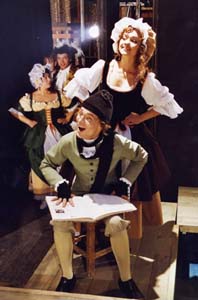
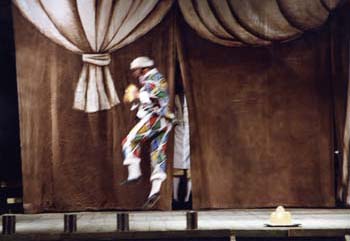
Servant of Two Masters
by
Directed by
Paolo Emilio Landi
Set & Costumes
Santi Migneco
Movements by
Lydia Biondi
Music by
Bach, Vivaldi, Tartini
produced by
the Saratov Youth Theatre