|
|
 |
ABOUT THE PLAY AND PLAYWRIGHT
Much of what is fascinating, if not entirety true, about
Carlo Goldoni's life
can be read in Memoirs of Carlo Goldoni: Written by Himself This curious and
passionate account represents the reconstructed memories of a 75-year-old man;
five years from his death and enamored with the life he had so joyously lived.
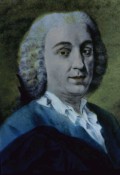
Carlo Goldoni, born in Venice in 1707, was destined for a theatrical career
by virtue of his ancestry. His paternal grandfather loved the performing arts.
Even when there was little money, Goldoni celebrated life by regularly hosting
operas and plays featuring Italy's most gifted actors and musicians. Carlo's
father, Giulio Goldoni, also nurtured his son's love of theater with a puppet
stage.
In fact, not only did Carlo's father arrange the tiny theater's construction,
but he called upon the talents of his friends to write and perform pieces for
his four-year-old son. At this tender age, the young Goldoni was quite accomplished
at reading and writing. In his own memoirs, Goldoni recalls hours spent in
his father's library with his books, "I employed almost all my leisure moments
in reading them. I even copied the passages with which I was most delighted."
Given his early love of books, perhaps it is not surprising that Goldoni claims
he wrote his first comedy at the age of eight. Though scholars disagree with
his version of the story, it is a charming notion. According to Goldoni, when
his father received this first playwriting sample, he insisted that his talented
son join him in Rome. In 1712, Giulio Goldoni had left his family behind to
study medicine. Reunited with his father, Carlo continued his own schooling
and, during holidays, Giulio made provisions for his son to perform in amateur
productions. During this experience, it became clear that Carlo Goldoni would
never be an actor!
Instead, Carlo's father hoped that he would become a physician like himself
However, young Goldoni was very unhappy with the profession. Seeing this, Carlo's
mother found a way for her son to pursue study in the law through employment
with an attorney in Venice.
At 16, Carlo Goldoni received the opportunity to continue these studies at
the College of Ghislieri, known as the Pope's College. The unusual requirements
for entry were a certificate verifying good moral conduct, a certificate proving
he was unmarried, a baptismal certificate, and, if the church were to supply
funds, Carlo must shave the crown of his head in an appropriate "tonsure." Opting
to keep his hair in exchange for a lot of red tape, Goldoni applied for and
received funding from the senate. Additionally, a fortunate error wit his birth
certificate showed his age to be 18, allowing him to pass the minimum age requirement.
While on summer holiday, Goldoni engaged in his favourite past time: reading
comic plays. During his first summer at home, he was given a copy of Niccolò Machiavelli's
THE MANDRAKE which would play a huge role in the creation of his later works. "It
was the first comedy of character which had ever fallen into my hands and I
was quite enchanted with it."
 Goldoni's
third year at university would unfortunately be his last. Tricked by
Goldoni's
third year at university would unfortunately be his last. Tricked by
jealous classmates, he was placed under house arrest for possession of pistols.
Assured that his pen would prove an even mightier weapon for revenge, Goldoni
was encouraged to write an Atellano. This short, farcical dramatic form originated
with the Romans. Its subject matter most often involved cheating, gluttony,
fighting, and sexual exploits. Goldoni's "characters" would be several
respectable Italian families who immediately demanded his expulsion for the
comic work. Their wish was granted.
This expulsion would send Goldoni back to the study of law in 1727. He would
finally receive his doctorate from the University of Padova in 1731 and be
admitted to the bar a year later. Perhaps guided by his "theatrical" nature,
Goldoni won his first big case in 1733, but fled the city immediately afterward
to escape huge financial pressures and an unwelcome marriage.
Finally, in 1734, Goldoni officially began his career as a playwright by writing
scenarios for commedia troupes in and around Venice. However, from the beginning,
he was unhappy with many of the forms conventions. He began to encourage reform
in 1738 by writing out the principal role in MAN OF THE WORLD. Five years later,
Goldoni would write his first complete comic text called A LADY OF CHARM, but
would not see it performed because of his need to flee from bad debts once
again.
The partnership he began with masterful commedia actor Antonio Sacchi on MAN
OF THE WORLD would provide Goldoni's next major writing job.
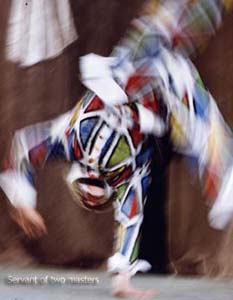
In 1744, Sacchi requested a written scenario for SERVANT OF TWO MASTERS which
was based on an older French theme. The play premiered in Milan a year later,
but would not boast a complete text by Goldoni until nine years later. His
many successes following SERVANT OF TWO MASTERS encouraged Goldoni to alter
the traditional character types for later works. A GIRL OF HONOR in 1749 would
mark the first time commoners were given equal importance on the stage. In
that same year, THE GENTLEMAN AND THE LADY would be the first Italian comedy
performed without masks. The nobility would continue to be outraged by this
innovation for the next 10 years!
By 1761, when Goldoni left Venice, he had done much to eliminate vulgarity
and unrealistic devices from commedia. Instead, he concentrated on finding
ways to include humor, sentiment, and realism. The stock characters appeared
softer and more human under Goldoni's pen. His
later works also revealed his respect for the middle and lower classes and
particularly women. his respect is most clearly illustrated in one of his most
famous works, THE MISTRESS OF THE INN.
His
later works also revealed his respect for the middle and lower classes and
particularly women. his respect is most clearly illustrated in one of his most
famous works, THE MISTRESS OF THE INN.
Late in his life, trouble with his eyes forced Goldoni to discontinue much
of his writing. This, combined with government reform, would plunge Carlo Goldoni
into utter poverty for much of his old age. In February of 1793, his government
pension was renewed following an impassioned plea to the National Convention.
Ironically, Goldoni never heard the praise nor benefited from the renewal;
he died on that same day -- poor and blind.
ACT ONE
House of Pantalone
Federigo, who is actually Beatrice disguised as a man, arrives. He/She expects Pantalone to pay her money that is due to Federigo. Brighella, a friend of the Rasponi house and owner of a hotel recognises Beatrice but agrees with her to not reveal her true identity. Truffaldino meets Smeraldina the house maid. He falls in love with her. The wedding is cancelled
Street
Truffaldino laments his condition as a servant. Florindo (Beatrice's lover) escaped from Turin after the death or Federigo, and arrives in Venice. Truffaldino applies to work as his servant and brings his trunk to the nearby hotel. he is sent to the post office to check for letters for Florindo Aretusi. Beatrice arrives at the same hotel and sends him to the post office to retrieve letters as well.
Silvio, wanting to meet Federigo, asks for Truffaldino's master. Florindo arrives. They think there is a misunderstanding. Florindo learns from Silvio that Federigo is alive and in Venice. He wants to return to Turin to search for Beatrice. Truffaldino mixes up the letters and gives Beatrice's letters to Florindo, who learns she is in Venice. He leaves in search of her. Truffaldino tries to reseal Beatrice's letter with a piece of bread. (letter Lazzo) Beatrice sees that the letter has been opened. She beats Truffaldino and sends him m the hotel. She leaves in search of Pantalone. Truffaldino meets Pantalone who gives him the money for his master. Truffaldino gives it to Florindo.
House of Pantalone
Clarice resists her father's will- She does not want to marry Federigo. Beatrice, seeing her desperation, tells her the truth; she is a woman. Clarice agrees to keep the secret, and gives her hand to Beatrice to show loyalty Pantalone sees this and believes that she has agreed to the Wedding. He leaves in search of Lombardi.
ACT TWO
Outside Pantalone's house
Silvio wants to fight Pantalone. His father, Lombardi, stops him and meets Pantalone. They talk. Pantalone informs him that the wedding between Clarice e and Federigo is decided. Silvio returns. Attacts Pantalone with words and challenges him. Beatrice intervenes and disarms Silvio. She's about to kill him when Clarice enters. Beatrice let Silvio go and reminds her the vow of silence. Clarice assures Silvio of her love, but he does not believe it. She is ready to commit suicide when Smeraldina stops her. Monologue of Smeraldina about men. Silvio leaves to seek revenge.
Hotel
Truffaldino meets Florindo, who allows him to order lunch. Then, Truffaldino receives the same order from Beatrice. Shegives him a cheque for 4000 ducats to be kept in her trunk. Truffaldino discusses the menu and table setting with Brighella He shows the intended placement with tearing into pieces the Cheque. Beatrice arrives to lunch with Pantalone. She discover the shredded cheque and beats him. She goes in her room to lunch. Arrives Florindo and does the same. Beatrice and Florindo are in two adjoining rooms. With the help of the waiter Truffaldino serves the meal to both masters.
Road
Smeraldina searches for Federigo. Skye has a letter from Clarice. She meets Truffaldino who declares his love for her. They try to read the letter but can not. Beatrice sees the open letter. Truffaldino and Smeraldina blame each other. Beatrice beats Truffaldino Florindo sees it and beats Truffaldino too.
ACT THREE
Hotel
Truffaldino brings both his masters' trunks to the same hotel room. Gives the clothes an airing. Finds in a coat Florindo's portrait. When Florindo calls him from off stage mixes up dresses and books, putting the portrait in a black coat. Florindo asks for a black coat. He receives one and finds his portrait (once presented to Beatrice) inside of it. As an excuse Truffaldino says he received the portrait from "is previous master who is now dead. Florindo believing Beatrice is dead exits in desperation. Beatrice asks for his ledger book which is in the trunk and receives one of Florindo containing her love letters. Truffaldino repeats the story of the dead master. Beatrice believing Florindo is dead, confesses that he is a woman, and desperately exits
Street
Pantalone, who has discovered the truth identity of Beatrice, meets Lombardi and tells him that the marriage between Silvio e Clarice is possible. Lombardi refuses the offer. Comes Silvio and Pantalone tells him the wedding `still possible as Federigo is a woman.
Hotel
Beatrice and Florindo try to commit suicide and meet by chance. Alive! Their joy is immense. They plan to go back to Turin and to buy Florindo's freedom. Who is responsible for these misunderstandings? Brighella brings Truffaldino, who convinces both masters separately that the responsible party is another servant named Pasquale. He tells them that Pasquale is the servant of the other and that they should not talk about him. Truffaldino asks Florindo for permission to marry Smeraldina
House of Pantalone
The wedding between Clarice and Silvio is set again. Beatrice and Florindo are going to be married as well. Florindo asks Pantalone for permission to marry his servant to Smeraldina. Clarice says that Smeraldina is promised to Beatrice's servant. In order to marry Smeraldina, Truffaldino confesses he is the servant of both masters. Discovered the truth all masters chase Truffaldino who, escaped, monologues about love.




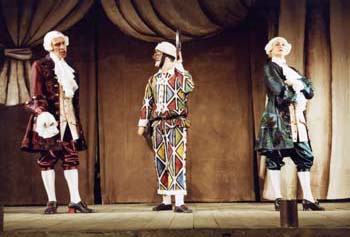
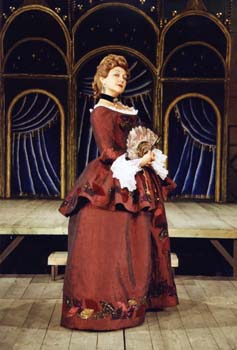
Servant of Two Masters
by
Directed by
Paolo Emilio Landi
Set & Costumes
Santi Migneco
Movements by
Lydia Biondi
Music by
Bach, Vivaldi, Tartini
produced by
the Saratov Youth Theatre